
You post three times a week on Instagram. A few people like the posts, your follower count creeps up, and nobody has asked about your services. Meanwhile, a competitor seems to be everywhere. At our digital marketing agency in India, this is the most common social media story we hear, and the cause is rarely effort. It is usually a missing social media marketing strategy.
A social media marketing strategy gives every post a job. This guide gives you a six-step method, a one-page template, a platform check using India data, and a 30-day launch plan. Social is one of the types of digital marketing, and it works best when it has one clear purpose.
| The short answerPick one business goal, one audience and one or two platforms. Choose three or four content themes, set a weekly rhythm you can keep, and tag every link so you can see which posts bring visitors and leads. Review the numbers monthly and change one thing at a time. |
What is a social media marketing strategy?
A social media marketing strategy is a written plan that links your social media activity to a business goal. It names the goal, the audience, the platforms, the content themes, the posting rhythm and the numbers you will track. Without it, posting is just activity. With it, every post has a job.
A content calendar is not a strategy. A calendar says what you will post and when. A strategy says why you are posting, who it is for and how you will know it worked.
How to build a social media marketing strategy in six steps
Work through these in order. Each step narrows the next one, so skipping ahead usually means redoing work.
- Set one goal. Choose one outcome for the next 90 days: awareness, website visits, leads or customer support. Several goals split your effort. Write it as a sentence with a number you set yourself, such as “20 inquiries from social media in 90 days”.
- Define one audience. Describe a single buyer: their role, their main problem and the question they would ask a search engine or a colleague. “Everyone aged 18 to 45” is not an audience.
- Choose one or two platforms. Go where that buyer already spends time and where your team can show up every week. The next section helps you decide.
- Pick three or four content pillars. These are the themes you return to, so your feed has a pattern instead of random posts.
- Set a rhythm you can keep. Decide how many posts a week, who creates them, who replies to comments and messages, and how long that takes. Fewer posts that you keep up beat a burst that fades.
- Measure and review. Choose the metric that matches your goal, tag your links, and review once a month.
Put the answers on one page. Here is a template you can copy into a document or spreadsheet.
| Strategy element | The question to answer | Example format |
|---|---|---|
| Goal | What result do we want in 90 days? | A number plus a deadline |
| Audience | Who exactly are we talking to? | Role, problem, question they ask |
| Platforms | Where is that buyer, and where can we post weekly? | One or two names |
| Pillars | Which 3 or 4 themes will we repeat? | Teach, prove, connect, invite |
| Rhythm | How often, who creates, who replies? | Posts per week and named owners |
| Measure | Which metric proves the goal, and where is it? | One metric plus its report |
A framework from Toplers. If you cannot fill a row in one sentence, that row is the next thing to work on.
Which social media platforms should a business use?
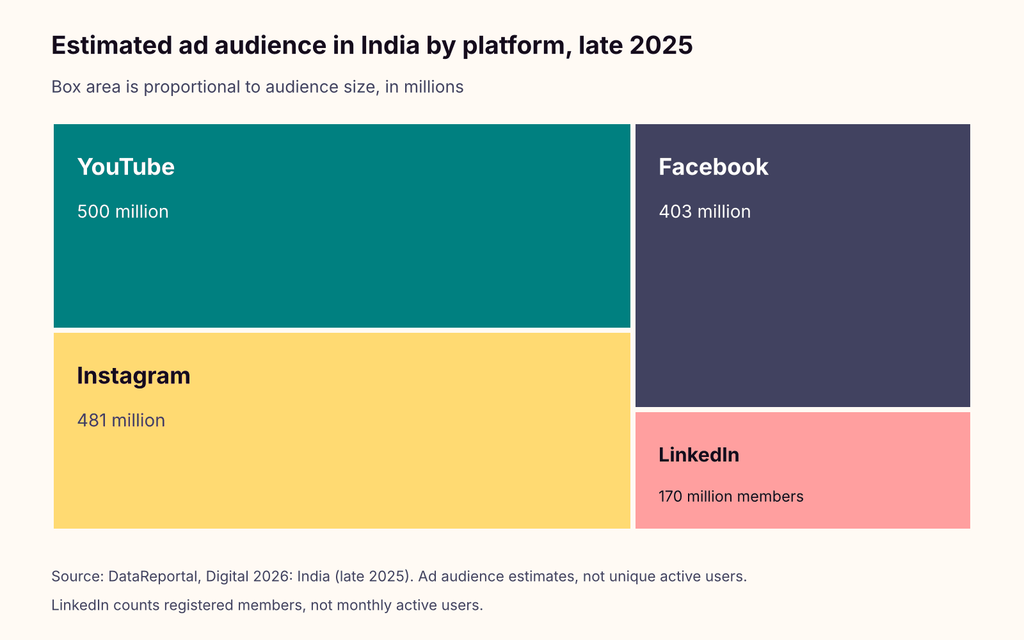
Choose by buyer, not by trend. Platform size helps you sense the scale, but a big audience does not mean your buyer is in it. For India, DataReportal’s Digital 2026 report estimates late 2025 ad audiences of 500 million for YouTube, 481 million for Instagram, 403 million for Facebook and 170 million members on LinkedIn.
Read those numbers with care. They are ad audience estimates, not unique active users, and LinkedIn counts registered members. DataReportal also warns that its source data is revised often, so compare year to year with caution.
| Platform | Often suits | Watch out for |
|---|---|---|
| Visual and short video content, consumer services, people-led brands | Needs a steady supply of visuals | |
| B2B services, professional expertise, hiring | Slow to build, and needs a real voice, not ads in disguise | |
| Local businesses, events, community groups | Posts alone may reach few people, so groups and replies matter | |
| YouTube | How-to videos and demos that people search for | Production takes the longest |
That table is our judgment from agency experience, not platform data. Use it as a starting hypothesis. A simple test: pick the platform where your buyer already is, where you can post every week, and where a click can lead to a page that asks for something.
If you are deciding how much to put into social media compared with other channels, our free marketing budget planner suggests how to split a monthly budget by goal.
What should you post? Build four content pillars
Content pillars stop you from asking “what do we post today?” every morning. For a services business, we suggest starting with four.
- Teach: answer the questions your buyers ask before they hire you.
- Prove: show real work, real process and real outcomes. Only share results you can verify.
- Connect: show the people, opinions and values behind the business.
- Invite: make a clear offer, such as an audit, a demo or a consultation.
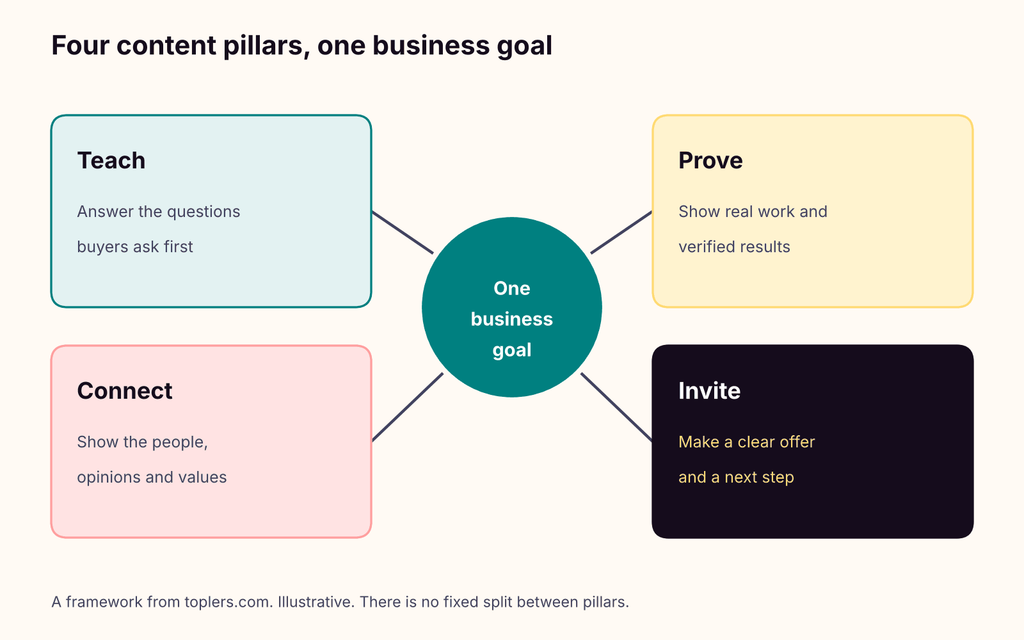
Every pillar should lead back to the goal. If a post fits no pillar, skip it. There is no fixed split between the four. Most businesses start with more teaching than inviting, then adjust after a month of results.
Social media is two-way, so plan time for engagement. Reply to comments and messages within a day, and ask questions your buyers can answer. Paid ads are optional. They put a strong post or offer in front of a chosen audience, but they amplify a strategy, not replace one. Test organically first, then promote what already works.
On who should create the content: Sprout Social’s 2026 Social Media Content Strategy Report found that consumers rank human-generated content as the top priority for brands. The survey covered more than 2,300 consumers in the US, UK and Australia, so it is not India-specific. Use AI for ideas, outlines and drafts if you like, but put real people and real work in front of your audience.
How do you measure social media marketing?
Pick the metric that matches your goal. Likes feel good, but they rarely pay the bills.
| If your goal is | Watch this metric | Where to find it |
|---|---|---|
| Awareness | Reach and follower growth | Each platform’s insights |
| Website visits | Sessions from social | Google Analytics acquisition reports |
| Leads | Form fills and calls from social | Your conversion tracking and CRM |
| Customer care | Reply time to comments and messages | Platform inbox |
To see social traffic clearly, add UTM parameters to every link you post. Google Analytics Help says to always use utm_source, utm_medium and utm_campaign, and to keep names consistent, because values are case sensitive. For example: utm_source=instagram, utm_medium=social, utm_campaign=free-audit.
Add one more safety net. Put “How did you hear about us?” on your inquiry form, because many people see a post, then search your name later. Review all of this monthly, and change only one thing at a time, such as a pillar, a format or a posting day. Otherwise you cannot tell what caused the change.
A 30-day launch plan
A strategy on paper does nothing until it is live. This plan gets you to a first review in four weeks.
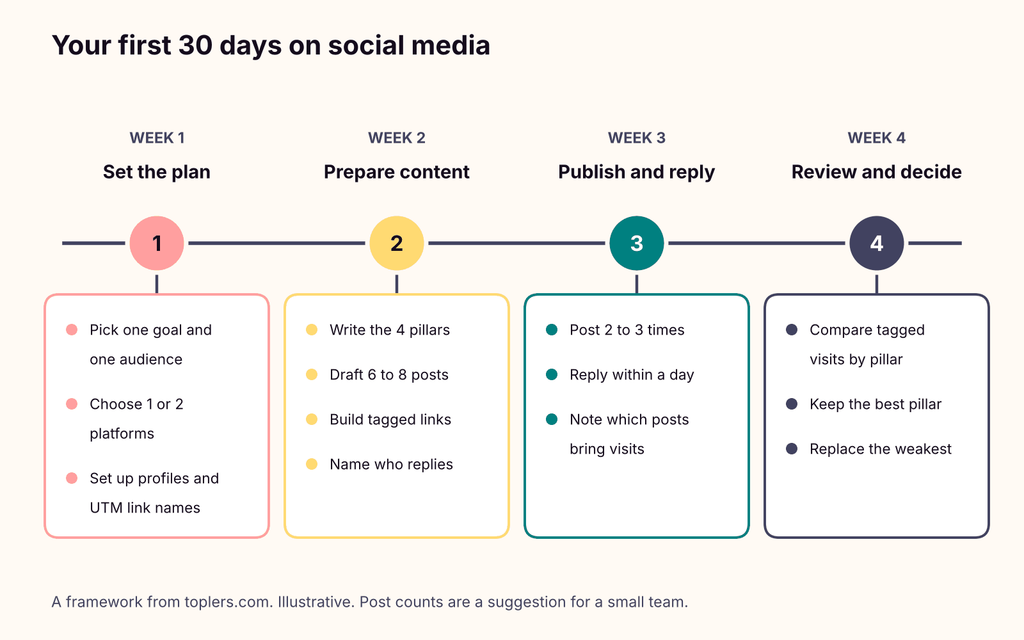
The post counts are our suggestion for a small team, not a benchmark. Lower them if you cannot keep up. At the end of week 4, keep the pillar that drove the most tagged visits or inquiries, replace the weakest one, and set the goal for the next 30 days.
The example below is a hypothetical scenario to illustrate the process. It is not a real client.
A 12-person accounting software company in Jaipur wants demo requests. Its goal is 10 demos in 90 days. Its buyer is a finance manager at a mid-sized firm who searches for ways to cut month-end work. The team chooses LinkedIn only. Its pillars are compliance explainers (teach), a walkthrough of one product task (prove), a founder’s view on the industry (connect), and a monthly demo offer (invite). It posts three times a week, one named person replies within a day, and every link carries UTM tags. At the day-30 review, the team compares tagged visits by pillar and adjusts the mix.
Social media marketing myths and reality
| Myth | Reality |
|---|---|
| “We need to be on every platform.” | Two platforms done well beat six done thinly. |
| “More followers means more customers.” | Followers measure audience size. Leads measure business results. |
| “We must post every day.” | A rhythm you can keep for 90 days beats a daily burst that stops. |
| “Going viral is the goal.” | Reaching the right buyers matters more than reaching many people. |
| “Posting alone will bring leads.” | Leads usually need a clear offer, a trackable link and a fast reply. |
When a social media strategy is not the right move yet
Hold off, or fix the gap first, in these cases:
- Nobody can post and reply every week, so the account will go quiet.
- You cannot describe your buyer in one sentence.
- Your website has no clear offer or a broken inquiry form, so attention has nowhere to go.
- Your buyers mostly search with clear intent. Search may bring leads sooner than social.
- You need inquiries this month. Organic social builds slowly, so start with search, or with follow-ups to people who already know you.
In each case, fix the gap first, then post.
Frequently asked questions
How do I create a social media marketing strategy?
Start with one goal, one audience and one or two platforms. Then choose three or four content pillars, set a posting rhythm you can keep, and tag your links so you can measure results. Review monthly and change one thing at a time.
Which social media platform is best for business in India?
No single platform is best for every business. DataReportal estimates late 2025 ad audiences in India of 500 million for YouTube, 481 million for Instagram, 403 million for Facebook and 170 million LinkedIn members, but size is not the test. Pick the platform where your buyer already is.
Which social media platform is best for B2B?
LinkedIn is the usual starting point for B2B because it is built around professional profiles and job roles, but it is not the only option. YouTube suits how-to and demo content that buyers search for. Choose by where your specific buyer spends time, and test before you commit.
How often should a business post on social media?
Post as often as you can keep up for 90 days. There is no official number. Many small teams start with two or three posts a week on one platform and add more only when the routine feels easy.
How do I measure social media ROI?
Tag every link with UTM parameters, track the leads that come from social, and compare their value with your costs. Costs include time, tools and any ad spend. Also ask new leads how they heard about you.
Do I need paid ads on social media?
No, paid ads are optional. Organic posting can work on its own, but it is slow. Many businesses test posts organically first, then pay to promote the ones that already bring visits or inquiries.
Where to go from here
A strategy is only as good as what you can measure. At Toplers we set up tracking before any ad spend, and clients own their ad accounts, website and data. If you want a team to run this plan, see our social media marketing and management services, built on more than eight years of hands-on experience in search, paid media and automation.
Want a second opinion before you commit? Request a free audit and we will review your website, ads and competitors, with no obligation.
Sources
- DataReportal, Digital 2026: India. Social media user identities and platform ad audiences for India, mostly late 2025. Ad audience estimates, not unique active users.
- Sprout Social, The 2026 Social Media Content Strategy Report. Survey of more than 2,300 consumers in the US, UK and Australia and more than 1,200 marketers. Consumers rank human-generated content as the top priority for brands.
- Google Analytics Help, URL builders: Collect campaign data with custom URLs. How to use utm_source, utm_medium and utm_campaign, and why consistent naming matters.