
Your website gets visitors and your phone rings now and then, yet your sales team says the leads are weak. So every month you try a new tactic and never learn which one worked. As a lead generation agency in India, we see this pattern often. The problem is rarely a shortage of methods. It is having no system to pick a few, run them and measure them.
This guide explains what a good lead is, compares 15 methods by speed, cost and effort, and shows how to score leads and hand them to sales. Lead generation is one part of the wider types of digital marketing, so use it to decide where to start.
| The short answerPick two or three methods that match your budget and sales cycle: one fast (usually paid search or outreach) and one that compounds (usually content or a free tool). Send every lead to a focused page, respond quickly, score leads on fit and intent, and judge results by cost per customer, not cost per lead. |
What is lead generation in digital marketing?
Lead generation is the process of attracting people who show interest in what you sell and capturing their contact details so you can follow up. In digital marketing, that means using search, content, ads, email and social channels to turn visitors into enquiries. A good lead fits your customer profile and has a real need.
There are two broad routes. Inbound methods bring people to you through content, search and tools. Outbound methods reach out to people first, through ads, email or direct messages. Most healthy lead engines use both, because inbound compounds slowly and outbound produces conversations sooner.
What makes a lead good?
A name and an email address are not enough. A good lead has three things:
- Fit: they match the kind of customer you can serve well, in size, location and budget.
- Intent: they took an action that shows a need, such as asking for a quote.
- Reachability: you have a valid way to contact them, with their permission.
Speed matters too. A Harvard Business Review study of online sales leads at US companies, published in 2011, concluded that most companies were not responding nearly fast enough. The data is old and American, so treat it as a direction, not a target. Still, answering within hours rather than days is a cheap advantage.
Which 15 lead generation methods work, and how do they compare?
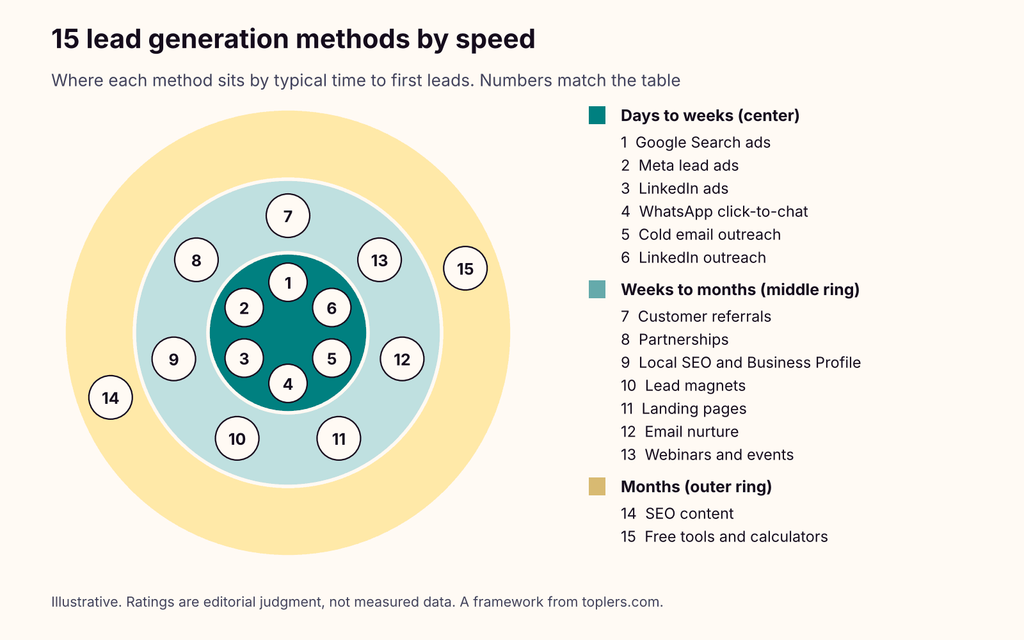
The table below ranks 15 common methods. The ratings are our own editorial judgment, not measured data. Your market, budget and offer will change them, so use the table to shortlist, then test.
| # | Method | Time to first leads | Typical cost | Effort |
|---|---|---|---|---|
| 1 | Google Search ads | Days | Medium to high | Medium |
| 2 | Meta lead ads | Days | Medium | Medium |
| 3 | LinkedIn ads | Days | High | Medium |
| 4 | WhatsApp click-to-chat | Days | Low | Low |
| 5 | Cold email outreach | Days to weeks | Low | High |
| 6 | LinkedIn outreach | Days to weeks | Low | High |
| 7 | Customer referrals | Weeks | Low | Low |
| 8 | Partnerships and co-marketing | Weeks to months | Low | Medium |
| 9 | Google Business Profile and local SEO | Weeks to months | Low | Medium |
| 10 | Lead magnets | Weeks | Low | Medium |
| 11 | Dedicated landing pages | Weeks | Low | Medium |
| 12 | Email nurture sequences | Weeks | Low | Medium |
| 13 | Webinars and events | Weeks to months | Medium | High |
| 14 | SEO content | Months | Low to medium | High |
| 15 | Free tools and calculators | Months | Medium | High |
A framework from Toplers. Ratings are editorial judgment.
The picture below sorts the same methods by how soon they tend to produce leads. The center is fastest.
Which organic methods build leads over time?
Organic methods take longer, but each asset keeps working after you publish it. SEO content answers the questions your buyers search for. Local SEO and a complete Google Business Profile help nearby customers find you. Both need patience, so expect months, not weeks.
A lead magnet is a free resource offered in exchange for contact details, such as a checklist, template or short guide. The best ones solve one narrow problem. A free tool goes a step further. Our free marketing budget planner is an example of a tool that gives value first and can start a conversation.
Referrals and partnerships are organic too. They cost little and often bring the best-fit leads, but they depend on relationships you have to build on purpose.
Which paid methods bring leads fastest?
Paid channels put your offer in front of people today. Google Search ads catch people who are already looking. Meta ads suit offers that make sense before someone searches. LinkedIn ads reach job titles and company types, which helps in B2B, though the clicks cost more.
Costs vary widely by industry. WordStream’s 10th Search Advertising Benchmarks report, covering Google and Microsoft Ads from April 2025 to March 2026 across 20 industries, puts the average cost per lead at $66.69 and the average conversion rate at 8.18%. Legal services averaged $131.63 per lead, while arts and entertainment averaged $26.84.
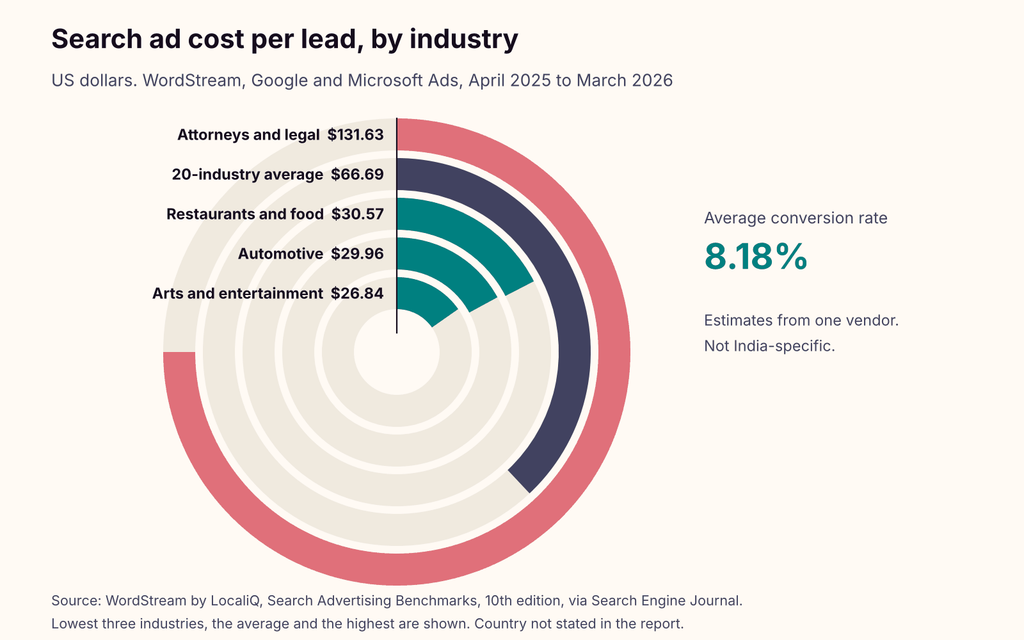
These are third-party estimates in US dollars from a vendor’s data, and the report does not state a country. They show how much costs differ, not what you will pay in India. Use your own account data as soon as you have it.
How do landing pages and email turn interest into leads?
Send paid and outreach traffic to a page built for one offer, not to your homepage. A good landing page has one clear promise, proof, a short form and one button. Ask only for what you need to follow up. Each extra field costs you some sign-ups.
Capture permission at the same moment. India’s Digital Personal Data Protection Rules, notified in November 2025, call for a separate, clear consent notice that explains the specific purpose of collection, and people may withdraw consent at any time, according to the Press Information Bureau. This is general information, not legal advice.
Then nurture. Most people are not ready on the first visit. A short email sequence that answers common doubts, shares proof and invites a call keeps you in mind until they are. WhatsApp can work well here, but you need clear opt-in first, and Meta’s rules say businesses must obtain opt-in before messaging people on WhatsApp.
How do you score and qualify leads?
Lead scoring gives each lead points for fit and intent, so sales calls the best ones first. Keep it simple at the start. Here is a template you can copy and change:
| Signal | Type | Points |
|---|---|---|
| Matches your target customer profile | Fit | +20 |
| Located in an area you serve | Fit | +10 |
| Budget confirmed as realistic | Fit | +15 |
| Asked for a quote or a call | Intent | +30 |
| Visited your services page twice or more | Intent | +10 |
| Downloaded a guide | Intent | +5 |
| Looks like a student or job seeker | Negative | -20 |
| No reply after three attempts | Negative | -10 |
A framework from Toplers. The point values are examples, so adjust them after you compare scores with real sales.
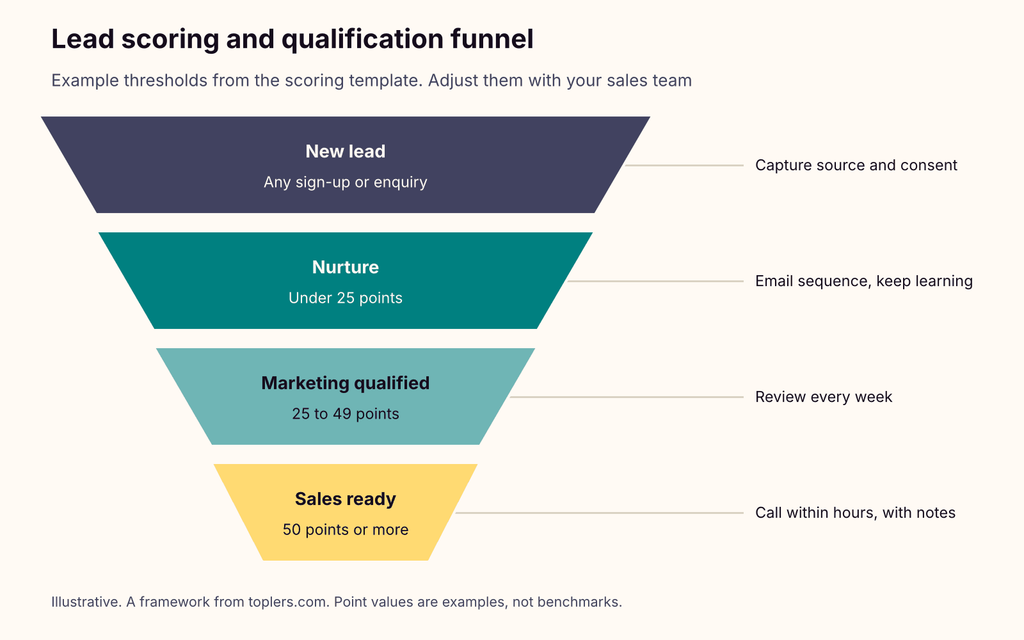
Under 25 points, keep nurturing by email. Between 25 and 49, mark the lead as marketing qualified and review it weekly. At 50 or more, pass it to sales with a note on what the person did. Agree on these thresholds with your sales team before you launch, or the handoff will cause arguments.
Which lead generation metrics should you track?
Track four numbers, and read them together:
- Cost per lead (CPL): spend divided by leads.
- Lead-to-customer rate: customers divided by leads.
- Customer acquisition cost (CAC): spend divided by new customers.
- Lead response time: how long it takes your team to reply.
CPL alone misleads. A channel with a cheap lead and a low close rate can cost more per customer than an expensive one that closes often. Set up tracking before you spend, so every lead carries its source.
The example below is a hypothetical scenario to illustrate the process. It is not a real client.
A small accounting software consultancy in Pune runs Google Search ads and a free checklist. The checklist produces more leads at a lower cost per lead, but after three months the owner sees that most checklist leads never reply. Search ad leads cost more and close more often. So the owner keeps both, adds a scoring rule that sends only replying checklist leads to sales, and judges each channel by cost per customer.
What mistakes lower lead quality?
- Chasing the lowest cost per lead and ignoring who the leads are.
- Sending all traffic to the homepage instead of a focused page.
- Long forms that ask for information you do not use.
- Slow replies, or no clear owner for new leads.
- Buying contact lists, which harms trust and may breach consent rules.
- Running six channels at once and measuring none properly.
When lead generation is not the right move yet
- Your offer is unclear, so you cannot say who it is for or why it is better.
- You cannot follow up fast, because nobody owns new leads.
- Your website has no tracking, so you cannot tell where leads come from.
- You already have more demand than you can serve.
- You need sales this week and have no budget or network to reach buyers quickly.
In each case, fix the gap first. More leads will only expose it.
Frequently asked questions
What is a good cost per lead?
It depends on your industry and offer, so there is no single good number. WordStream’s 2025 to 2026 search advertising data averaged $66.69 per lead across 20 industries, from $26.84 to $131.63. Compare cost per lead against your cost per customer instead.
How do I generate leads with no budget?
Start with referrals, direct outreach, a complete Google Business Profile and helpful content on topics your buyers search. These cost time rather than money. Add a simple lead magnet so visitors have a reason to share contact details.
What is a lead magnet?
A lead magnet is a free resource, such as a checklist, template or short guide, offered in exchange for contact details. It works best when it solves one narrow problem. Always explain how you will use the details you collect.
How do I qualify leads?
Check fit and intent. Fit means the lead matches the customer you serve well, and intent means they took an action that shows a need. A simple points system, such as the template above, helps your team decide who to call first.
What is the difference between inbound and outbound lead generation?
Inbound brings people to you through content, search and tools. Outbound reaches out to them first, through ads, email or messages. Inbound is slower but compounds, while outbound is faster but stops when you stop.
How fast should I respond to a new lead?
As quickly as you can, ideally within hours. Harvard Business Review’s 2011 study of online sales leads at US companies found that most were not responding nearly fast enough. Assign one owner to every new lead and set a response target.
Where to go from here
Good lead generation is a system you can see: every lead has a source, a score and an owner. At Toplers we set up tracking before any ad spend, and clients own their ad accounts, website and data. If you want help choosing and running the right methods, see our paid media and lead generation services, backed by more than eight years of hands-on experience in search, paid media and automation.
Want a second opinion first? Request a free audit and we will review your website, ads and competitors, with no obligation.
Sources
- WordStream by LocaliQ, Search Advertising Benchmarks (10th edition), reported by Search Engine Journal. Average cost per lead, conversion rate and industry ranges for Google and Microsoft Ads, April 2025 to March 2026, 20 industries. Vendor data in US dollars, country not stated.
- Harvard Business Review, The Short Life of Online Sales Leads (2011). Study of online sales lead response at US companies. Old, US-based data used only for direction.
- Press Information Bureau, DPDP Rules, 2025 Notified. Notification, 18-month phased compliance, separate consent notice and the right to withdraw consent. Government summary, not legal advice.
- Meta for Developers, WhatsApp Business Platform: Getting opt-in. Businesses must obtain opt-in before messaging people on WhatsApp.