
Someone fills in your enquiry form at 9 pm. Your team sees it the next afternoon, replies by hand, and the lead has already spoken to a competitor. Meanwhile a spreadsheet of old contacts sits untouched. As a marketing automation agency in India, we see this gap often. It is not a people problem. It is a missing system.
This guide explains what marketing automation is, the parts every setup needs, three workflows to start with, how to choose tools and how to measure the return. It is one of the types of digital marketing that works best after you have a steady flow of leads and a clear offer.
| The short answerMarketing automation uses software to send the right message when a person does something, so follow-up is fast and consistent. Start with a CRM, one trigger and one workflow, such as a welcome sequence or an enquiry follow-up. Get consent first, measure against a baseline, and add more only when the first one works. |
What is marketing automation?
Marketing automation is software that runs marketing tasks for you based on rules, such as sending a welcome email when someone signs up or alerting sales when a lead asks for a quote. It saves manual work and speeds up follow-up. It does not replace strategy or good content, because it can only send what you give it.
A simple way to think about it: you decide what should happen, and the software makes it happen every time, at any hour, for every contact. Typical jobs include sending welcome emails, reminding your team to call a lead, tagging contacts by interest and pausing messages once someone buys.
How is marketing automation different from email marketing?
Email marketing is a channel. You write a message and send it to a list, usually on a schedule. Marketing automation is a way of working. It reacts to behavior, such as a form fill, a link click or a period of silence, and can use email, WhatsApp, tasks for your team and more.
Email platforms often include automation features, so the two overlap. The difference is the logic. A newsletter goes to everyone on Friday. An automation goes to one person because of something they just did.
What are the core parts of an automation setup?
Every workflow, simple or complex, is built from the same four parts:
| Part | What it does | Example |
|---|---|---|
| CRM or contact database | Stores each person, their source and their history | A contact record with a source and consent date |
| Trigger | The event that starts the workflow | Someone submits your enquiry form |
| Condition | A check that decides the path | Is the lead in a city you serve? |
| Action | What the system does next | Send a reply and create a task for sales |
A framework from Toplers. If you can describe a workflow as trigger, condition and action, you can build it in almost any tool.
The contact database matters most. Salesforce’s State of Marketing 2026 report, a vendor survey of 4,450 marketers worldwide, says its high performers built data foundations first. It also found that organizations pull data from an average of seven sources, and only 26% of marketers are satisfied with how well that data connects. Messy data makes any automation worse.
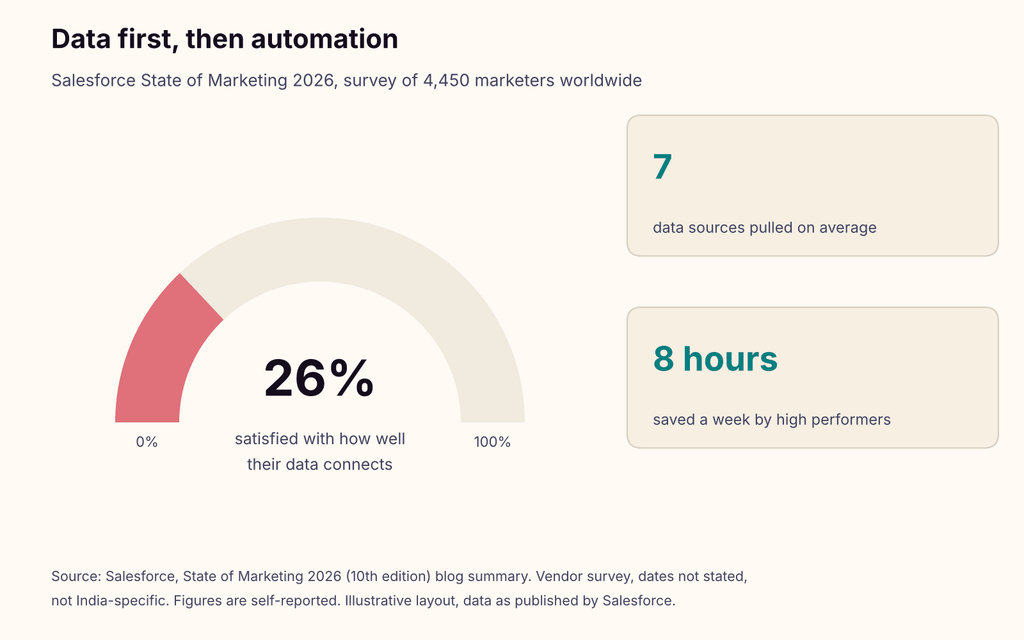
Treat those numbers as one vendor’s view. The survey dates are not stated, and the report is not India-specific. The lesson still holds: clean your contacts and connect your forms before you automate anything.
Which beginner workflows should you build first?
Start with three. Each has a clear trigger and a result you can count.
| Workflow | Trigger | Condition | Action |
|---|---|---|---|
| Welcome | New subscriber | Consent recorded | Send a short welcome series over about two weeks |
| New enquiry follow-up | Form submitted | Fits your service area | Instant reply, task for sales, reminder if no contact |
| Re-engagement | No clicks for a long period | Still has consent | One reminder, then stop if there is no response |
A framework from Toplers. Adjust the timing to your sales cycle.
The enquiry follow-up usually delivers the quickest win, because it fixes the 9 pm problem from the start of this guide. The picture below shows one version as a swimlane, so you can see who or what does each step.
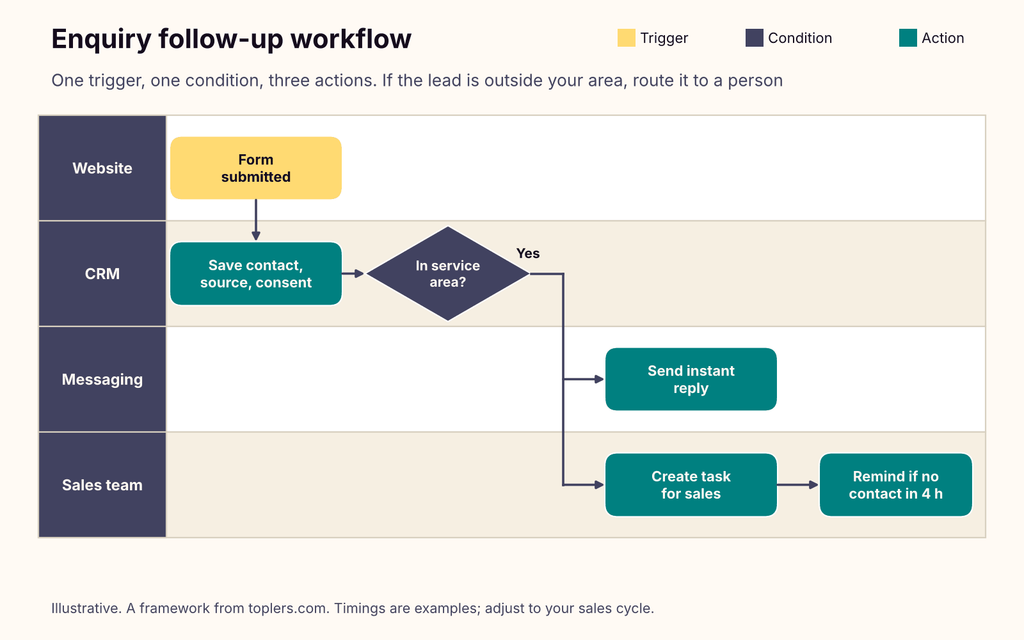
Keep the reply honest and useful. Confirm you got the message, say when a person will respond and give one helpful link. The reminder to sales is the part that stops leads from slipping.
Brevo, an email platform, publishes benchmarks that hint at why automated messages are worth building. In its 2025 data from more than 175,000 customers, automated emails had a 30.63% open rate and a 7.39% click-through rate, compared with 20.73% and 2.27% for regular campaigns. That is vendor data, not India-specific, and opens can be inflated by mail privacy features, so judge your own results.
How do you choose marketing automation tools?
Tools fall into layers. You do not need all of them on day one. Start at the bottom and move up only when you hit a limit.
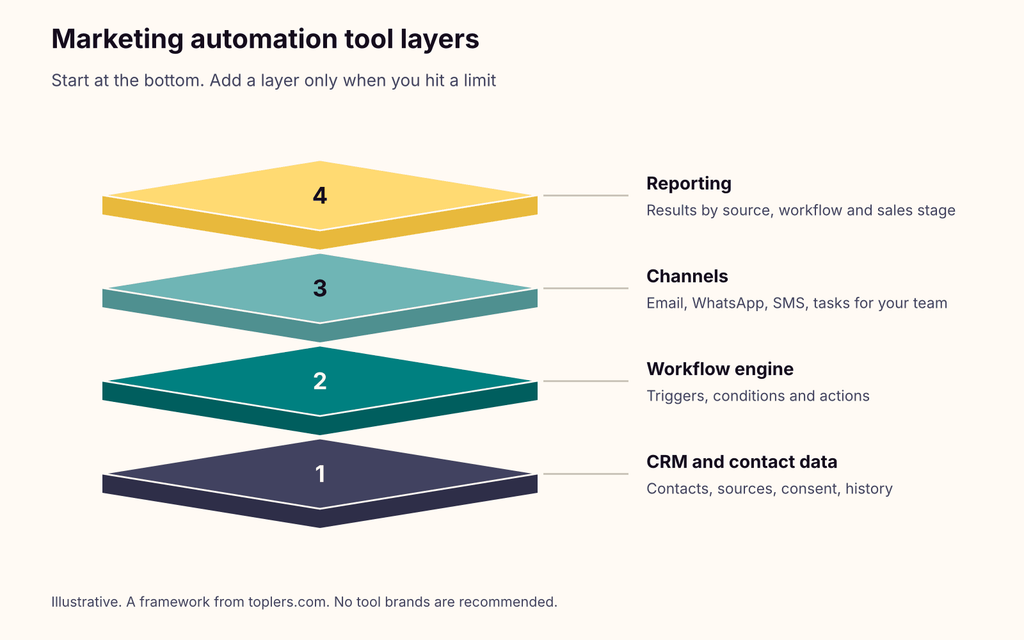
No single tool suits every business, so compare on needs instead of brand names. Use this checklist:
| Question | What to check |
|---|---|
| Does it hold your contacts? | A CRM with sources, tags and a record of consent |
| Can it build workflows without code? | A visual builder with triggers, conditions and actions |
| Does it reach your channels? | Email now, and WhatsApp or SMS if your buyers use them |
| Does it connect to your forms and ads? | Direct links or a connector for your website and ad platforms |
| Can you see results? | Reports by source, workflow and sales stage |
| Do you own your data? | A full export of contacts and history at any time |
| Will the price stay sensible? | How cost changes with contacts and features |
A framework from Toplers. Pick the cheapest option that passes the first five rows.
How do you connect automation with ad platforms?
Your ads should feed the same system as your website. Route leads from ad forms and landing pages into one CRM, tag each with its source, and trigger the same follow-up. Most major ad platforms and CRMs offer some way to connect, but the options differ, so check your specific tools before you commit.
This also fixes reporting. When every lead carries its source and later its sales outcome, you can judge channels by customers won, not only by clicks. At Toplers, we set up tracking before any ad spend for this reason.
What do consent and platform rules mean for automation?
Automation makes it easy to message people at scale, so permission matters more. India’s Digital Personal Data Protection Rules, notified in November 2025, call for a separate, clear consent notice that explains the specific purpose of collection, and people may withdraw consent at any time, according to the Press Information Bureau. This is general information, not legal advice.
Platform rules add more. Meta’s developer documentation says businesses must obtain opt-in before messaging people on WhatsApp, and that the opt-in must make clear who the business is and what messages to expect. Store when and how each person agreed, and give an easy way to stop.
How do you measure the return on automation?
Measure before you build, so you can compare. Track these four things:
- Response time: how fast a new lead gets a first reply.
- Lead-to-customer rate: the share of leads that become customers.
- Hours saved: manual tasks removed, counted honestly.
- Cost per customer: total spend, including tools, divided by new customers.
Salesforce’s survey says its high performers save an average of eight hours a week through automation. Treat that as a self-reported vendor figure, not a promise. Count your own hours before and after instead.
The example below is a hypothetical scenario to illustrate the process. It is not a real client.
A physiotherapy clinic in Jaipur gets enquiries from its website and a Meta form. Today, reception replies the next day. The clinic builds one workflow: an instant confirmation, a task for reception and a reminder after four hours. For a month it tracks first reply time and booked appointments against the month before. It keeps the workflow only if bookings rise or replies get faster.
What are the common pitfalls?
- Automating a broken process, which only makes mistakes faster.
- Building ten workflows before one works.
- Messy contact data, with duplicates and missing sources.
- Messages that feel robotic, with no easy way to reach a person.
- Ignoring consent and unsubscribes.
- No owner, so nobody checks whether workflows still make sense.
Review each workflow monthly. Read a few real messages, check the numbers and switch off anything that no longer helps.
When marketing automation is not the right move yet
- You get only a handful of leads a month, so a manual reply is still fine.
- Your offer and sales process are not defined yet.
- You have no permission-based contact list or consent records.
- Nobody can own the setup and review it each month.
- You expect software to fix weak leads or a weak offer.
In each case, fix the foundation first. Automation multiplies what already exists.
Frequently asked questions
Is marketing automation only for big companies?
No. Small businesses often gain the most, because one simple workflow can replace hours of manual follow-up. Start with a single workflow, such as an enquiry reply, and expand only when it works. Choose tools that fit your contact volume.
What is the difference between email marketing and marketing automation?
Email marketing sends messages to a list, usually on a schedule. Marketing automation sends messages and actions triggered by what a person does, across email, WhatsApp and internal tasks. The two overlap, since many email platforms include automation.
Which CRM should I use?
No single CRM is best for everyone. Choose one that stores contact sources and consent, builds workflows without code, connects to your forms and ads, and lets you export your data. Start with the cheapest option that passes those checks.
What should I automate first?
Automate the follow-up to new enquiries first. It has a clear trigger, fixes slow replies and is easy to measure. After that, add a welcome sequence and a re-engagement email.
Can I automate WhatsApp messages?
Yes, but you need opt-in first. Meta’s documentation says businesses must obtain opt-in before messaging people on WhatsApp, and the opt-in must clarify the business name and intent. Template messages generally need approval, so check the current rules.
How do I measure marketing automation ROI?
Record a baseline before you build, then compare response time, lead-to-customer rate, hours saved and cost per customer after a month or two. Include tool costs in the cost per customer. Keep a workflow only if the numbers improve.
Where to go from here
Good automation is simple, tracked and owned by someone. At Toplers, clients own their ad accounts, website and data, and we set up tracking before any ad spend. If you want help with workflows, CRM setup and connecting your channels, see our automation and CRM solutions, backed by more than eight years of hands-on experience in search, paid media and automation.
Want a second opinion first? Request a free audit and we will review your website, ads and competitors, with no obligation.
Sources
- Salesforce, State of Marketing 2026 (10th edition) blog summary. Survey of 4,450 marketers worldwide: data foundations, seven data sources on average, 26% satisfied with data connectivity, eight hours a week saved by high performers. Vendor survey, dates not stated.
- Meta for Developers, WhatsApp Business Platform: Getting opt-in. Businesses must obtain opt-in before messaging people on WhatsApp, and opt-in should clarify business name and intent.
- Press Information Bureau, DPDP Rules, 2025 Notified. Notification, 18-month phased compliance, separate consent notice and the right to withdraw consent. Government summary, not legal advice.
- Brevo, Email marketing benchmarks. 2025 data from more than 175,000 Brevo customers: automated versus campaign open and click-through rates. Vendor data, not India-specific.