
You have collected email addresses at events, through your contact form and from old customers. Once a quarter you send one big message to everyone. A chunk of it bounces, a few people unsubscribe, and the rest ignore it. As a marketing automation agency in India, we see this often, and the fix is rarely a better subject line. It is a better list and a simple email marketing system.
This email marketing guide covers the basics in the order you will need them: lists, platforms, campaigns, deliverability, metrics and your first automations. Email is one of the types of digital marketing where you own the audience, which makes it worth doing properly.
| The short answerBuild a list with clear permission, pick a platform that handles unsubscribes and authentication, and start with a welcome sequence plus one regular newsletter. Segment by simple groups, judge results by clicks and conversions instead of opens, and fix deliverability before you scale. |
What is email marketing and why does it still work?
Email marketing is sending messages to people who agreed to hear from you, such as newsletters, welcome emails and offers. It works because you own the list, so no algorithm decides who sees your message. It suits keeping leads warm and bringing customers back, and results depend on permission, relevance and getting delivered.
Email marketing will not find strangers for you. It works on people who already know you, which is why it pairs well with SEO, social and ads that bring those people in.
How do you build an email list the right way in India?
Start with permission. India’s Digital Personal Data Protection Rules were notified in November 2025 and phase in over 18 months, according to the Press Information Bureau. The government says each data fiduciary must issue a separate consent notice that is clear and easy to understand and explains the specific purpose of collection, and that people may withdraw consent at any time. This is general information, not legal advice, so check your own obligations.
In practice, a clean list follows five habits:
- Tell people what they will get and how often, right next to the signup box.
- Collect addresses only from people who chose to give them. Never buy or rent a list.
- Record when, where and for what purpose each person signed up.
- Put a working unsubscribe link in every email, and honor it quickly.
- Offer something worth an address, such as a checklist, a template or a calculator.
A free tool can be that offer. Our marketing budget planner is an example of a tool people may trade an address for, as long as you say clearly how you will use it.
How do you choose an email marketing platform?
There is no single best email marketing tool for every small business, so compare on needs, not brand names. Our checklist:
| Need | What to check |
|---|---|
| Signup forms | Embeddable forms that record consent and source |
| Segmentation | Tags or groups based on interest and behavior |
| Automation | Welcome and follow-up sequences without code |
| Deliverability support | Guided SPF, DKIM and DMARC setup, plus automatic unsubscribe handling |
| Reporting | Click and conversion tracking, not only opens |
| Ownership | Easy export of your full list |
| Cost | How the price changes as your list grows |
A framework from Toplers. Start with the cheapest plan that passes the first five rows.
Which types of email campaigns should you send?
| Type | Purpose | Timing |
|---|---|---|
| Welcome | Introduce yourself and deliver what you promised | Right after signup |
| Newsletter | Share useful content and stay known | On a schedule you set |
| Nurture | Answer questions that move a lead toward a decision | After a form fill or download |
| Promotional | Make one clear offer | When you have a real offer |
| Re-engagement | Win back quiet subscribers or let them go | After a long period of silence |
Start with the welcome email and one newsletter. Add the other types as your list and your capacity grow.
How do you write subject lines and email copy?
Write each email for one reader with one goal. Then apply these rules:
- Make the subject line clear and specific before you make it clever.
- Use the preview text to add a second reason to open.
- Lead with the benefit, and keep paragraphs short.
- Include one main call to action, and make the link text say what happens next.
- Send from a real name and monitor the reply address.
Never mislead with the subject line. It raises complaints, and complaints damage delivery, as the next section shows.
How should you segment your list?
Segmentation means sending different messages to different groups. You do not need a complex setup. Start with three groups: new subscribers, existing leads and customers. Then add one interest tag per main topic. A message that fits the group gets more clicks and fewer unsubscribes than one that fits no one. Test that on your own list, because we are describing a method, not a guarantee.
How do you keep your emails out of the spam folder?
Deliverability is built in layers. Permission is the base, and authentication, list hygiene and relevant content sit on top.
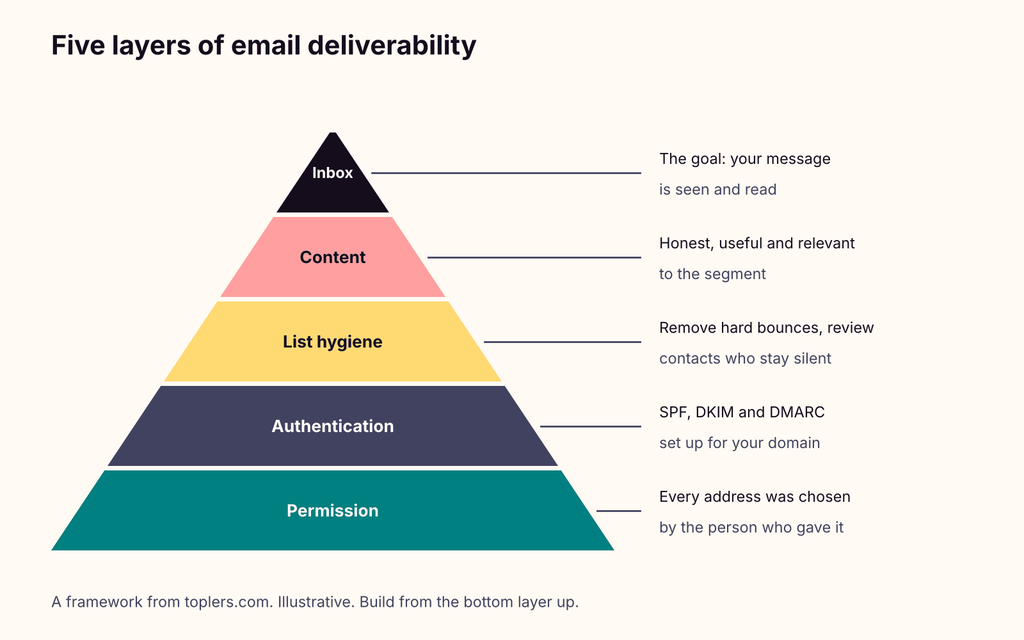
Google’s email sender guidelines define a bulk sender as one who sends close to 5,000 or more messages a day to personal Gmail accounts. Those senders must authenticate their mail with SPF, DKIM and DMARC, keep their spam rate in Postmaster Tools below 0.30%, and offer one-click unsubscribe on marketing messages. Google also says it has been ramping up enforcement since November 2025, so non-compliant mail can face temporary and permanent rejections.
A small list will likely stay below that volume, but the rules show what mailbox providers value, so follow them anyway. Use this checklist.
| Check | What good looks like |
|---|---|
| Consent | Every address came from a person who chose to join |
| Authentication | SPF, DKIM and DMARC are set up for your sending domain |
| Sender identity | A real name, and a reply address someone reads |
| Unsubscribe | A visible link that works at once |
| List hygiene | Hard bounces removed, long-silent contacts reviewed |
| Content | Honest subject line, balanced text and images |
| Complaints | Tracked, and kept far below 0.30% where Gmail data is available |
A framework from Toplers, based on Google’s published requirements.
Which email marketing metrics matter?
Opens are the least reliable number. Brevo, an email platform, reports its standard open rate excluding Apple Mail Privacy Protection, which preloads messages and can register opens that no person made. In its 2025 data, the Asia-Pacific open rate was 17.56% excluding those opens and 26.69% including them.
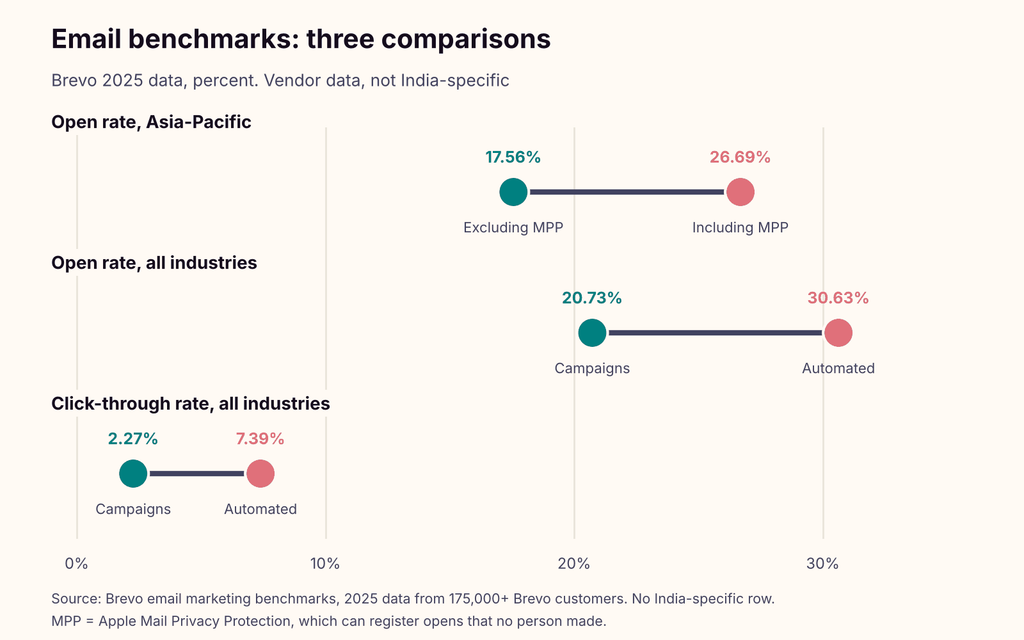
Brevo’s 2025 data covers more than 175,000 of its customers, so it reflects one vendor’s users. It has no India-specific row. Across industries, it reports a 20.73% average open rate, a 2.27% click-through rate for marketing campaigns and a 0.46% unsubscribe rate. Use these as context, not targets.
Track clicks, conversions (form fills, replies, sales) and unsubscribes. An unsubscribe is not a failure, because it keeps your list healthy. Automated emails performed better in the same data, which leads to your first automations.
Which email automation flows should you start with?
Start with a welcome sequence. It reaches people at their moment of highest interest and runs without extra work. Here is the template we suggest.
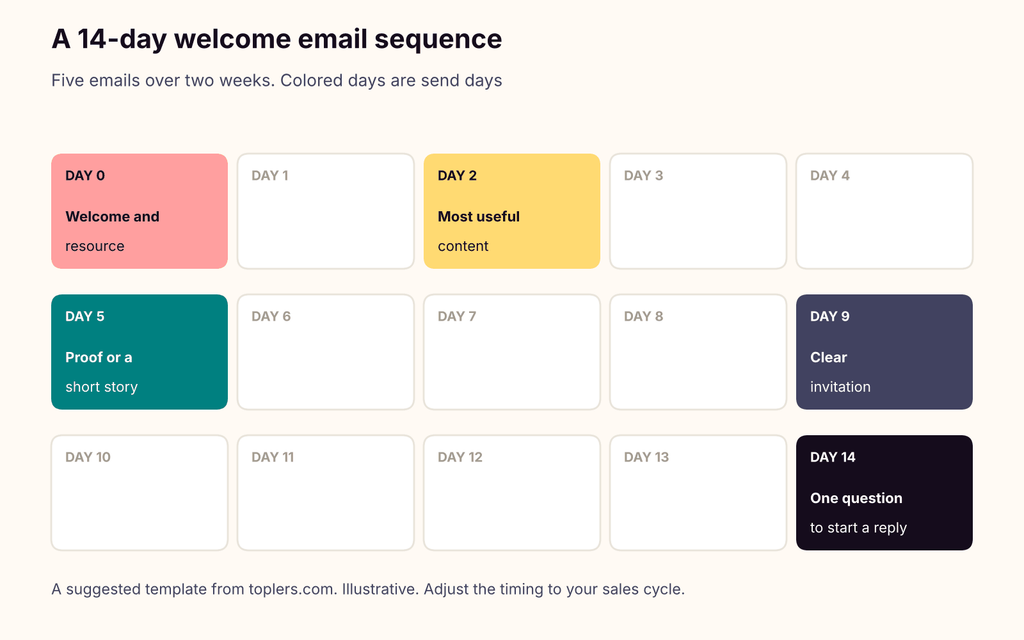
Day 0 delivers the promised resource. Day 2 shares your most useful piece of content. Day 5 shows proof, such as a short story of how you help. Day 9 makes a clear invitation, such as a call or an audit. Day 14 asks one question to start a reply. This is our suggested starting point, so adjust it to your sales cycle.
The example below is a hypothetical scenario to illustrate the process. It is not a real client.
A chartered accountancy firm in Ahmedabad offers a tax filing checklist for small businesses. Visitors enter an address and agree to monthly tips. The welcome sequence sends the checklist, a guide to common filing mistakes, a short story about fixing one, and an invitation to a call. Every email links to the next step and carries a working unsubscribe link. After 30 days, the firm checks clicks and booked calls, not opens, and rewrites the weakest email.
After the welcome sequence, add a nurture flow for people who download something, and a re-engagement email for contacts who have gone quiet.
When email marketing is not the right move yet
- You have no permission-based list and no way to collect addresses.
- Nobody can write and send on a regular schedule.
- Your website has no signup form or clear offer to send people toward.
- You plan to buy a list, which harms delivery and trust.
- You need leads this week. Email builds on an audience, so pair it with search or ads first.
In each case, fix the gap first, then send.
Frequently asked questions
What is a good email open rate?
There is no single good rate, and opens are unreliable because Apple Mail Privacy Protection can inflate them. Brevo’s 2025 data reports an average open rate of 20.73% excluding those opens, across industries. Judge your emails by clicks and conversions instead.
How often should I email my list?
Email as often as you promised at signup and can keep up with. Many small teams start with one newsletter a month or every two weeks, plus the welcome sequence. Watch unsubscribes and complaints, and slow down if they rise.
How do I avoid spam folders?
Send only to people who agreed, authenticate your domain with SPF, DKIM and DMARC, and include a working unsubscribe link. Keep complaints very low, because Google says bulk senders must keep their spam rate below 0.30%. Remove bounced addresses and avoid misleading subject lines.
Which email tool is best for a small business?
No single tool is best for everyone. Choose one that handles consent forms, segmentation, simple automation, authentication setup and clear reporting at a price that fits your list size. Check that you can export your list at any time.
Do I need consent to email people in India?
Yes, you should get clear permission before you email people. India’s DPDP Rules, notified in November 2025, require a clear consent notice explaining the purpose, and say people may withdraw consent at any time. Most duties phase in over 18 months, and this is not legal advice.
What is a welcome email sequence?
A welcome sequence is a short series of automatic emails sent after someone joins your list. It delivers what you promised, shares useful content and invites a next step. A sequence of four to five emails over about two weeks is a good start.
Where to go from here
Email marketing works best when you can see what each message produces. At Toplers we set up tracking before any ad spend, and clients own their ad accounts, website and data. If you want help with lists, campaigns and automation, see our email marketing and automation services, backed by more than eight years of hands-on experience in search, paid media and automation.
Want a second opinion first? Request a free audit and we will review your website, ads and competitors, with no obligation.
Sources
- Gmail Help, Email sender guidelines. Requirements for sending to personal Gmail accounts, including the 0.30% spam rate limit and one-click unsubscribe for senders above 5,000 messages a day.
- Gmail Help, Email sender guidelines FAQ. Definition of a bulk sender (close to 5,000 or more messages a day to personal Gmail accounts) and the note on stronger enforcement from November 2025.
- Press Information Bureau, DPDP Rules, 2025 Notified. Notification date, 18-month phased compliance, separate consent notice and the right to withdraw consent. Government summary, not legal advice.
- Brevo, Email marketing benchmarks. 2025 data from more than 175,000 Brevo customers. Vendor data, not India-specific. Open rates exclude Apple Mail Privacy Protection unless stated.