
Your team published 20 blog posts last year. Traffic is flat, the posts rarely get shared, and sales say no prospect has ever mentioned them. That usually means you have a pile of content, not a system. At our digital marketing and automation agency, we see this most often in teams that write when they find time and never decide who each post is for.
This guide follows the order you will actually work in: strategy, topic clusters, a creation workflow, distribution, measurement and refreshes. Content is one of the types of digital marketing that builds over time, and it only pays off when it has a plan.
| The short answerChoose one goal and one audience. Build a few topic clusters around pillar pages, write with real expertise, and repeat a simple workflow. Share every piece in several places, measure leads rather than page views, and refresh what you already have before writing more. |
What is content marketing?
Content marketing is the practice of creating and sharing useful content, such as articles, videos, guides and tools, for a clearly defined audience. The aim is to earn trust, and then a profitable action such as an inquiry or a sale, by helping people before they buy instead of advertising at them.
It is not the same as SEO or advertising. SEO helps people find your content, ads pay for attention, and content marketing supplies the substance both of them point to. Without useful content, SEO and ads have little to show.
Which content types and formats should you use?
Match the format to the question your buyer is asking. This is our view from agency work, not research data.
| Format | Works well for | Main cost |
|---|---|---|
| Blog article | Answering search questions and building topic depth | Writing and expert time |
| Case study | Proof late in the decision | Client permission and real data |
| Video | Demos and how-to explanations | Production time |
| Email newsletter | Staying in touch with people who know you | Steady consistency |
| Calculator or template | Earning links and leads | Build time |
| Short social posts | Reach and repurposed ideas | Weekly upkeep |
Start with one or two formats you can sustain. Add more once your workflow runs smoothly.
How do you build a content marketing strategy?
Strategy comes down to four decisions. Write each one in a single sentence.
- Audience. One buyer, their main problem and the questions they ask before they hire or buy.
- Goal. One result you can judge at 90 days, such as inquiries that come from content. Content builds slowly, so avoid goals that need results in a week.
- Pillars. Three to five themes where you have real expertise and the audience has real demand.
- Capacity. How many pieces a month your team can finish to a high standard, who creates them and who approves them.
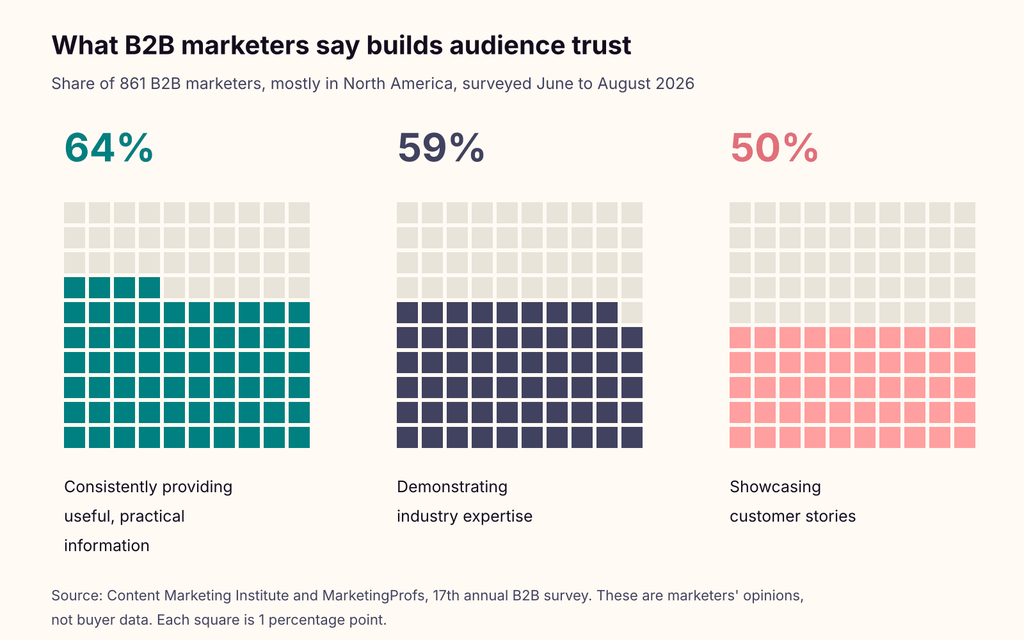
Research can guide the mix. In the Content Marketing Institute’s 2026 B2B survey, marketers named consistently providing useful, practical information (64%), demonstrating industry expertise (59%) and showcasing customer stories (50%) as top trust builders. The sample was 861 B2B marketers, mostly in North America, surveyed from June to August 2026. These are marketers’ opinions, not buyer data.
What are topic clusters and pillar pages?
A pillar page is a broad guide to one main topic. Cluster articles go deep on its subtopics. Each cluster article links up to the pillar, and the pillar links down to each cluster. This shows readers and search engines how your content on a topic fits together. It is a widely used industry practice, not a Google requirement.
We are using this structure ourselves. This encyclopedia on toplers.com is being built as a hub, pillar guides such as this one, and cluster articles on each subtopic, linked in both directions. It is a live project, so we have no results to report yet. We plan to update this section after the first month of data.
Before you add a cluster, check what you already have. When two of your pages target the same question, they compete with each other. Give every page one main question.
The example below is a hypothetical scenario to illustrate the process. It is not a real client.
A 10-person interior design studio in Hyderabad wants inquiries for full-home projects. Its audience is families renovating a two or three bedroom apartment. Its pillar page is a complete guide to renovating an apartment. The cluster articles cover budget planning, choosing a contractor, kitchen layouts and timelines. Each one links to the guide, and the guide links back. The studio publishes two cluster articles a month, turns each into a short video and a checklist, and judges the plan at 90 days by inquiries that mention the content.
What does a content creation workflow look like?
A repeatable workflow beats heroic effort. The cycle below has six stages, and each stage has one owner.
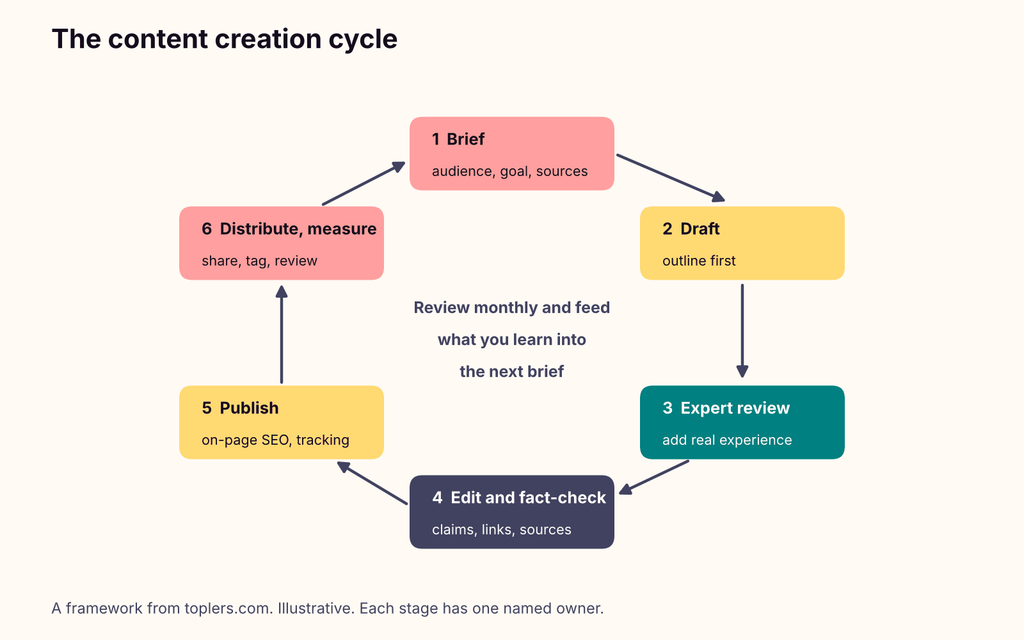
The brief is the step teams skip most often, and it prevents the drift that wastes drafts. Use this template before anyone writes a word.
| Brief field | What to write |
|---|---|
| Audience and question | Who is asking, and what they want to know |
| Goal of the piece | The one understanding or action you want |
| Main keyword and intent | The phrase, and the kind of answer people expect |
| Expert source | Who supplies the real experience or data |
| Evidence | Sources to cite, with data year and country |
| Next step | The single link or call to action |
| Distribution plan | Where it will be shared, decided before writing |
A framework from Toplers. If you cannot fill a row, the piece is not ready to write.
How do SEO and E-E-A-T apply to content?
Google says its ranking systems prioritize helpful, reliable content made to benefit people, not content made mainly to attract search visits. Its guidance asks you to consider Who created the content, How it was produced and Why. Make the author obvious, and say so when automation or AI was used and readers would reasonably expect to know.
Two common habits are worth dropping. Google’s guidance says it has no preferred word count, so write as long as the question needs. It also lists changing page dates to look fresh, without significant changes, as a warning sign.
Can AI help? Yes, with care. Google says generative AI can be useful for researching a topic and adding structure to original content. It also says it is critical to manually fact-check and review all AI-generated content before publishing, and that producing many pages without adding value may violate its spam policy on scaled content abuse. In the CMI survey, ensuring accuracy and quality control were the top AI challenges, each named by 54%. Use AI for outlines and first drafts, then add real experience, real data and a human edit.
How do you distribute and repurpose content?
Publishing is not distribution. Plan where each piece will be seen in three groups: owned (your site, email list and profiles), earned (shares, links and mentions from others) and paid (promotion).
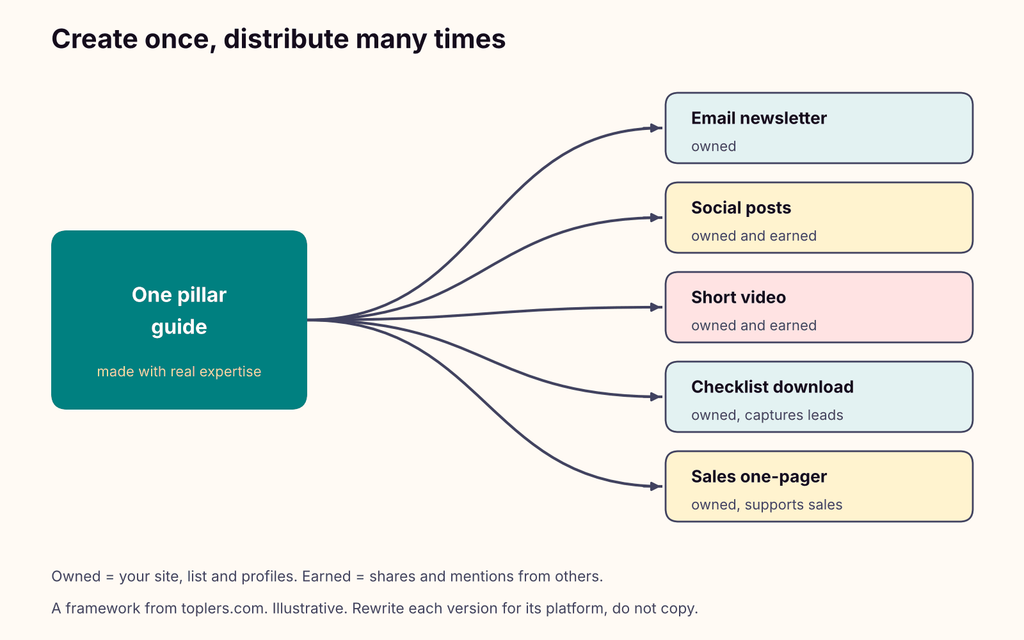
Decide the repurposing before you write. One guide can become a newsletter, several social posts, a short video, a checklist and a sales one-pager. Rewrite each version for its platform instead of pasting the original.
How do you measure content marketing?
| Stage | Metric | Where to look |
|---|---|---|
| Visibility | Impressions and clicks for target queries | Google Search Console |
| Engagement | Engaged sessions and return visits | Google Analytics |
| Leads | Form fills, calls and replies from content pages | Conversion tracking and CRM |
| Revenue | Deals that started from content | CRM with the source recorded |
Tag the links you share with UTM parameters, and ask “How did you hear about us?” on your forms. Review monthly, but judge a piece only after at least 90 days, because search content builds slowly.
When should you audit and refresh old content?
Review your existing posts twice a year and give each one of four actions.
| Action | When | What to do |
|---|---|---|
| Keep | Accurate, found and producing leads | Leave it, and link to it from new posts |
| Update | Right topic, outdated facts | Replace data, add expert insight, then republish |
| Merge | Two posts answer the same question | Combine into the stronger URL and redirect the other |
| Remove | Off-topic, thin or wrong | Delete, or redirect to a relevant page |
Update only when there is something real to change. A new date alone does not count.
What team and tools do you need?
A small team can cover five roles: an owner who sets strategy and approves, a writer, a subject expert who supplies real experience, an editor who fact-checks, and someone who handles distribution and reporting. One person can hold several roles. Keep tools simple: a shared document, a calendar spreadsheet, Search Console and Analytics. Buy more only when a process breaks.
When content marketing is not the right move yet
- Nobody with real expertise can contribute, so the content will be generic.
- You cannot publish steadily for at least 90 days.
- You need leads within weeks. Content builds slowly, so pair it with paid search or direct outreach.
- Your website has no clear offer or a broken inquiry form, so readers have nowhere to go.
- You have no way to record where leads come from, so you could not prove it worked.
In each case, fix the gap first, then publish.
Frequently asked questions
How often should I publish content?
Publish as often as you can keep to a high standard for at least 90 days. Quality and consistency matter more than volume. For many small teams that means one or two strong pieces a month, with more added once the workflow feels easy.
What is a pillar page?
A pillar page is a broad guide to a main topic that links to more detailed cluster articles, which link back to it. It gives readers one place to start and shows how your content on the topic connects. It is an industry practice, not a Google requirement.
How long should blog posts be?
As long as it takes to answer the question well. Google’s guidance says it has no preferred word count. Check what the best pages for your query cover, then add what they miss.
Can AI write my content?
AI can help with research, outlines and drafts, but it should not publish on its own. Google says to manually fact-check and review all AI-generated content before publishing, and mass-producing pages without added value may break its spam policy. Add real experience and a human edit.
What is the difference between content marketing and SEO?
Content marketing creates useful content for an audience, while SEO makes that content easy to find in search. They work together. SEO without good content has little to rank, and good content without SEO may never be found.
How do I measure content marketing ROI?
Track visibility, engagement, leads and revenue separately. Tag links with UTM parameters, record the source of each lead in your CRM, and judge results after at least 90 days. Then compare the value of those leads with your time and spend.
Where to go from here
A content engine only works when you can measure it. At Toplers we set up tracking before any ad spend, and clients own their ad accounts, website and data. If you want help building one, see our content marketing and SEO services, backed by more than eight years of hands-on experience in search, paid media and automation.
Want a second opinion first? Request a free audit and we will review your website, ads and competitors, with no obligation.
Sources
- Google Search Central, Creating helpful, reliable, people-first content. People-first content, Who, How and Why, no preferred word count, and the warning about changing dates without significant changes. Page shows an update date of 10 November 2026.
- Google Search Central, Using generative AI content on your website. Manual fact-checking of AI content, and the scaled content abuse spam policy. Page shows an update date of 1 October 2026.
- Content Marketing Institute, B2B content and marketing trends research. 17th annual CMI and MarketingProfs survey, 861 B2B marketers in this summary, mostly North America, fielded June 23 to August 11, 2026.